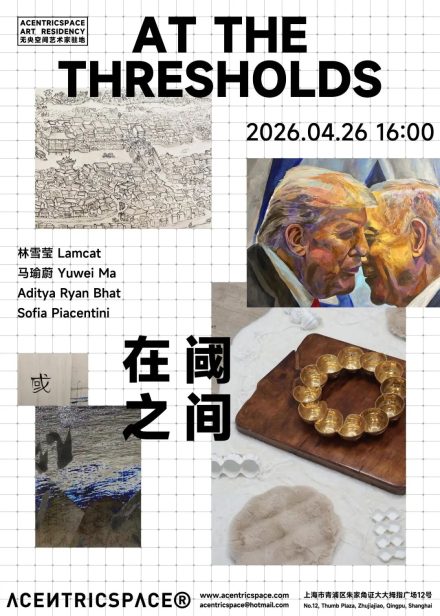
Aditya Ryan Bhat
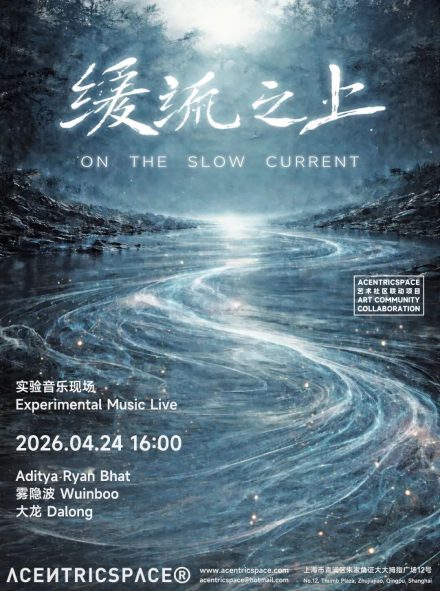
你可以再次靠近一条河流,却无法再次进入同一次水的经过。
在连续之中,差异被掩盖;在缓慢之中,差异开始显现。
这场演出以“缓流”作为一种时间结构:速度被降低到足以暴露细节,变化不再通过对比被感知,
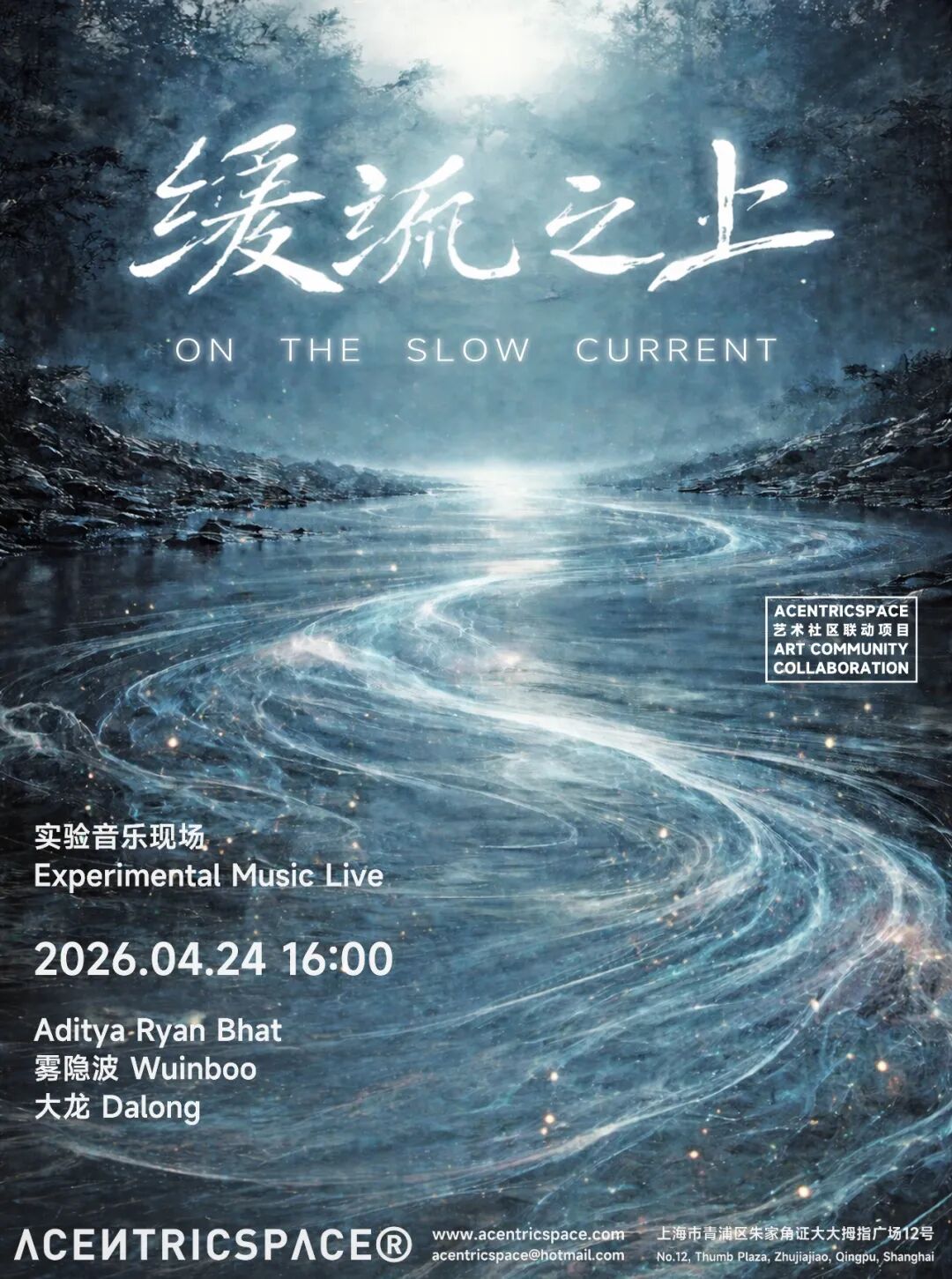
由Aditya Ryan Bhat构建的实验声响与打击结构,在精确与偏移之间形成脉冲的流动;雾隐波 Wuinboo的波斯Setar与电子声部,在音高与音色的微分变化中延展出呼吸般的时间;大龙Dalong的人声与吹奏,则在语言与气息的边界上生成不稳定的回声与形态。
微小的时间误差在累积,频率在持续游移,相位之间产生不稳定的对齐与脱离。
因此,没有一个瞬间可以被固定为“原点”,也没有一个段落可以被完整回溯。
层叠的声部如同不同深度的水流:表层缓慢推进,底部暗自改变方向,局部涌动在不被察觉的情况下生成。
聆听在此不再是对对象的捕捉,而是一种被卷入的过程。
你所听见的声音,在被感知的同时已经离开;你所经历的当下,在命名之前已经发生改变。
在控制与失控之间,结构被维持在临界状态:既不坍塌,也不稳定。
这不是一段可以被重复的声音,而是一条持续发生、不可逆的流。
你无法两次进入同一条河流,也无法两次听见同一个瞬间。
Water sustains itself through flow, yet never repeats itself.
You may approach a river again, but never enter the same passing of water twice.
What is called “the same” is only a delayed judgment.
Within continuity, difference is concealed; within slowness, it begins to surface.
This performance treats “slow current” as a temporal structure: speed is reduced to expose detail, change is no longer perceived through contrast, but through gradual internal deviation.
Sound is placed into loops, yet refuses to become repetition.
Experimental textures and percussive structures shaped by Aditya Ryan Bhat form a pulsating current between precision and deviation; the Persian setar and electronic layers of Wuinboo extend a breathing sense of time through microtonal and timbral shifts;
while the voice and wind expressions of Dalong generate unstable echoes and forms along the boundary of breath and speech.
Minute temporal discrepancies accumulate, frequencies continue to drift, and phases align and misalign in unstable relations.
No moment can be fixed as an origin, no segment can be fully retraced.
Layered voices resemble currents at different depths: the surface advances slowly,
the undercurrent shifts direction unseen, and localized turbulence emerges without announcement.
Listening is no longer an act of capturing an object, but a process of being drawn into it.
What you hear has already departed at the moment of perception; what you experience has already changed before it can be named.
Between control and loss of control, structure is held in a critical state: neither collapsing nor fully stable.
Like a current that continues forward, yet cannot point to a fixed “ahead.”
This is not a sequence that can be repeated, but a continuously unfolding, irreversible current.
You cannot enter the same river twice, nor hear the same moment twice.
Aditya Ryan Bhat
Aditya Ryan Bhat是一位现居澳大利亚Narrm(墨尔本)的音乐家。他运用原声与电子素材,创造出丰富多样的声音组合。Aditya接受过打击乐的专业训练,热衷于探索物体与乐器的物理特性,并将其与各种形式的合成音效、田野录音及实时处理技术相结合。他的音乐旨在探究殖民主义与帝国主义的历史,同当下的生态议题之间错综复杂的内在关联。
Aditya Ryan Bhat is a musician living in Narrm/Melbourne, Australia. He uses acoustic and electronic materials to create diverse combinations of sounds. Trained in percussion, Aditya experiments with physical properties of objects and instruments, combining them with various forms of synthesised sound, field recordings, and live processing. This music explores the interconnections between the histories of colonialism/imperialism and ecological issues.
美院背景的声音创作者,持续在艺术创作与商业实践之间游走。其作品横跨广告、现代舞、院线电影与新媒体艺术等领域。现场演出以合成器与采样为基础,结合原声乐器,在克制的框架中制造富有呼吸感与细微变化的声音场景。
A sound artist with a fine arts background, he navigates fluidly between artistic creation and commercial practice. His work spans advertising, contemporary dance, theatrical cinema, and new media art. In live performance, he builds on synthesizers and sampling, integrating acoustic instruments to craft restrained sonic environments imbued with a sense of breath and subtle variation.
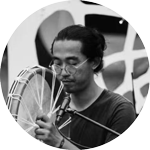
世界音乐研习者和流动艺术活动主办,自幼学习手风琴打击乐
先后参与演出泰国香巴拉音乐节 上海戏剧节 阿那亚戏剧节 乌镇戏剧节
Flow 其实就是道家思想里说到的「无为」—顺势而为,它其实是一种身体法门,我们通过与一个道具或乐器在力学的对话中,去感受那个运动势能,去跟随瞬息万变的「无常」,并且全神贯注地跟随它进入到那种流动中去—这就是我们现在所说的一种「心流 flow」状态。
A world music enthusiast and organizer of nomadic art events, he has studied accordion and percussion since young.
He has participated in performances at the Shambhala Music Festival in Thailand, the Shanghai Theatre Festival, the Anaya Theatre Festival, and the Wuzhen Theatre Festival.
Flow is actually the Taoist concept of “wuwei” (non-action)—going with the flow. It is a physical method where we interact with a prop or instrument through a mechanical dialogue to feel the potential energy of motion, to follow the ever-changing “impermanence,” and to wholeheartedly follow it into that flow—this is what we now call the state of “flow.”






![[超]灾变论 [Hyper-]Catastrophe Theory 舜 Shun](https://www.acentricspace.com/wp-content/uploads/2020/10/wxsync-2024-04-17e42ddfe2087d093ffcdad3f414da34-440x625.jpeg)