贾佳 Jia Jia

ACENTRICSPACE第200位驻地艺术家

2026年八月驻地艺术家
贾佳

No. 200 ACENTRICSPACE Resident Artist

2026 August Resident Artist

Jia Jia


 关于艺术家 About the Artist 
(中国 China

www.jiajiajj.com
Instagram: @jiaj.i.a
 

贾佳是一位现居美国西雅图的跨媒介艺术家,创作涵盖雕塑、陶瓷与装置艺术。她于2021年获得美国华盛顿大学(University of Washington3D4MThree-Dimensional Forum)艺术硕士学位,并于2016年获得中央美术学院产品设计学士学位。

她的作品曾在多个艺术机构与展览空间展出,包括 SOIL Artist-Run GalleryRoot DivisionField Projects GalleryLangston Hughes Performing Arts InstituteJacob Lawrence Gallery 以及 Henry Art Gallery。她的创作亦曾被 ArtConnectArtMaze Magazine The Seattle Times等媒体与出版物报道。贾佳曾参与多个驻留项目,包括Virginia Center for the Creative ArtsShunpike Artist Residency 以及 Kimmel Harding Nelson Center for the Arts。目前,她是西雅图艺术家运营空间 SOIL Artist-Run Gallery 的成员。
Jia Jia is an interdisciplinary artist based in Seattle whose work explores how individuals continuously redefine identity, belonging, and value in a world shaped by globalization, migration, and social expectations. Working across sculpture, ceramics, installation, and mixed media, she examines the ways cultural systems, language, and social structures influence personal and collective experiences. 
Jia Jia received an MFA in 3D4M from the University of Washington (2021) and a BFA in Product Design from the China Central Academy of Fine Arts, Beijing (2016). Her work has been exhibited at venues including SOIL Artist-Run Gallery, Seattle Art Fair, Field Projects Gallery, The Vestibule, Jacob Lawrence Gallery, and Henry Art Gallery. Her work has been featured in publications such as ArtConnect, ArtMaze Magazine, and The Seattle Times. 
She has participated in residencies at the Virginia Center for the Creative Arts, Shunpike Artist Residency, and the Kimmel Harding Nelson Center for the Arts. Jia Jia is a member of SOIL Artist-Run Gallery in Seattle and is a recipient of a 4Culture Projects Grant.
“作为一名跨媒介艺术家,我运用泥、文本、厨房用具以及外科手术器械等材料,将文化适应视为一种发生在身体与物质层面的过程进行探索。通过雕塑与装置创作,我关注语言、意识形态与社会制度如何塑造移民经验,并影响个体对于价值与归属的理解。
我的创作从烹饪、保存、消化与解剖等行为中汲取隐喻,通过构建具有触觉性的空间与物质环境,呈现脆弱性、韧性与转化之间持续存在的张力。通过将感性的材料体验与观念性研究相结合,我的实践探讨身份如何在迁徙、翻译与跨文化协商的过程中不断被重塑与生成。”
“As an interdisciplinary artist, my work explores the complexities of cultural adaptation, identity, and the subtle violence of assimilation. I use tactile materials, clay, text, kitchen utensils, surgical tools, and more to construct immersive installations that reflect the immigrant body as both vulnerable and resilient. Through metaphors of cooking, preservation, and dissection, I examine how language, ideology, and societal norms shape and distort our sense of self. By combining sensory materials with conceptual inquiry, I aim to create spaces that invite reflection on personal and collective transformation in a world shaped by migration and cultural hybridity.”
 过往作品  Previous Works 
 
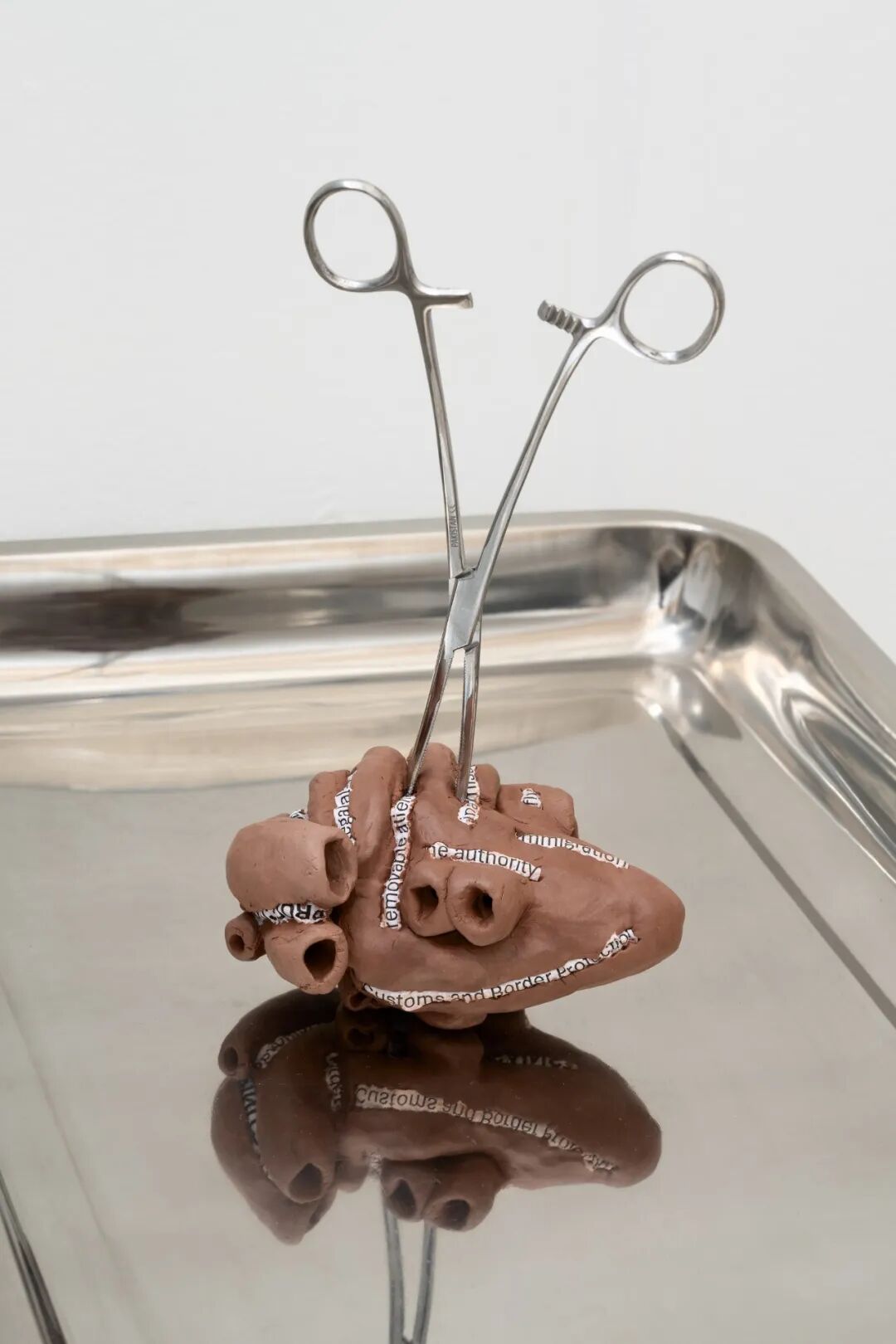
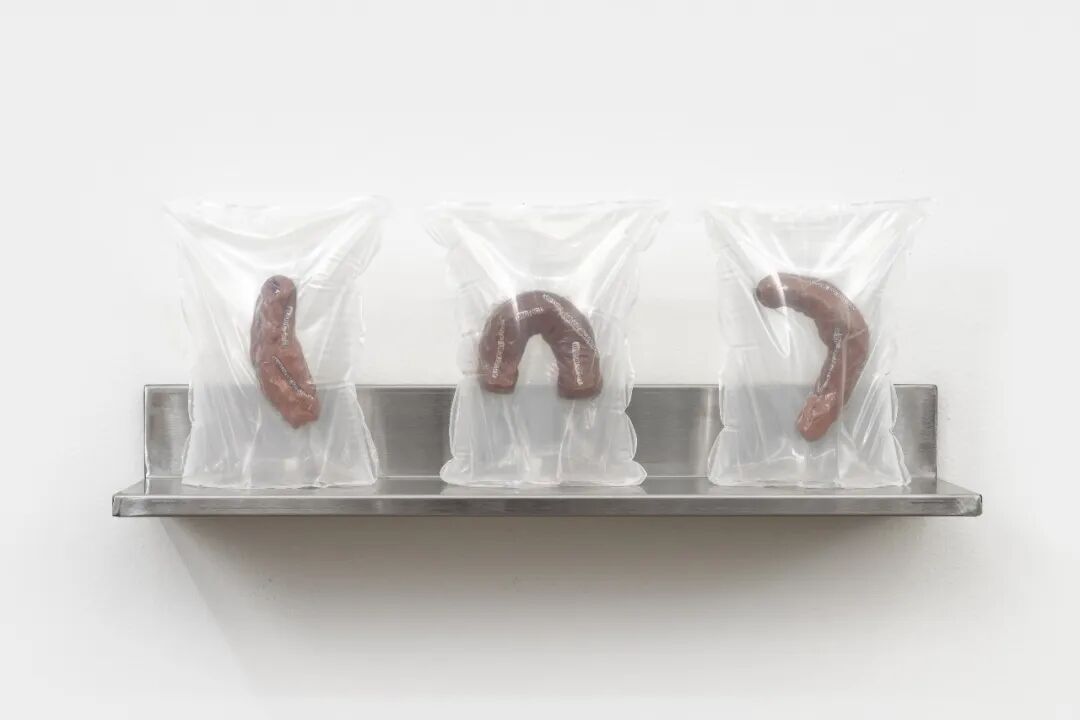
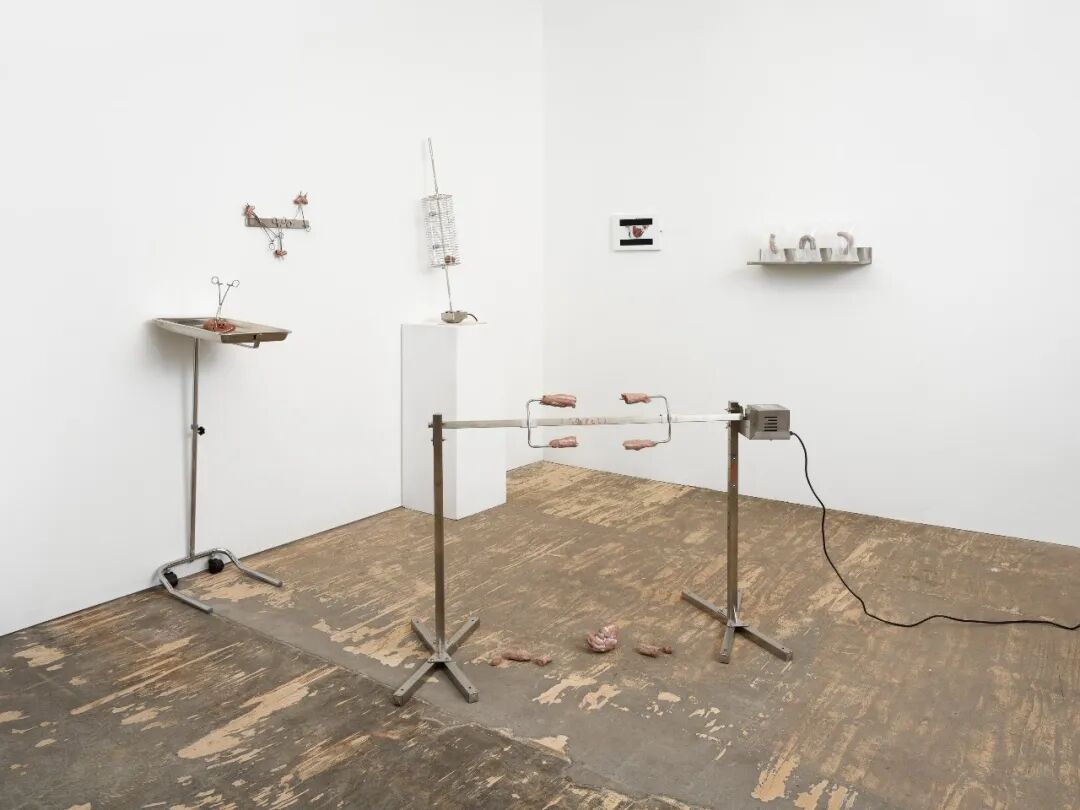
剩余价值 Surplus Value
未烧制陶泥,现成品,美国国土安全部(DHS)移民政策文件(2025),影像
Raw clay (terra cotta), found objects, Government immigration policy document (DHS, 2025), video
尺寸可变 Variable dimensions
摄影 Photo credit: Jueqian Fang
2025

这个系列作品运用泥、文本、厨房用具、外科手术器械、包装材料与影像,探讨个人身份如何在迁徙、翻译与跨文化协商的过程中不断生成。作品中的身体元素时而具象,时而抽象,以泥塑承载来自移民政策、新闻及日常媒介的文本碎片,并与不同材料共同构成一个关于身体、制度与物质关系的场域。身体在这里既是容器,也是媒介,它不断吸收、消化、转译并重组来自外部世界的信息,映照个体如何在全球流动、制度规范与文化碰撞之中持续协商自身的位置与价值。
This body of work employs clay, text, kitchen utensils, surgical instruments, packaging materials, and video to explore how identity is continually formed through migration, translation, and cross-cultural negotiation. Bodily forms appear at times recognizable and at times abstract, with clay sculptures embedding fragments of text drawn from immigration policies, news, and everyday media. Together with a range of found materials, these elements create a space that examines the relationship between the body, institutions, and material culture. Here, the body functions as both a vessel and a medium, continually absorbing, digesting, translating, and reassembling information from the outside world, reflecting how individuals continuously negotiate their place and value amid global mobility, institutional structures, and cultural encounters.
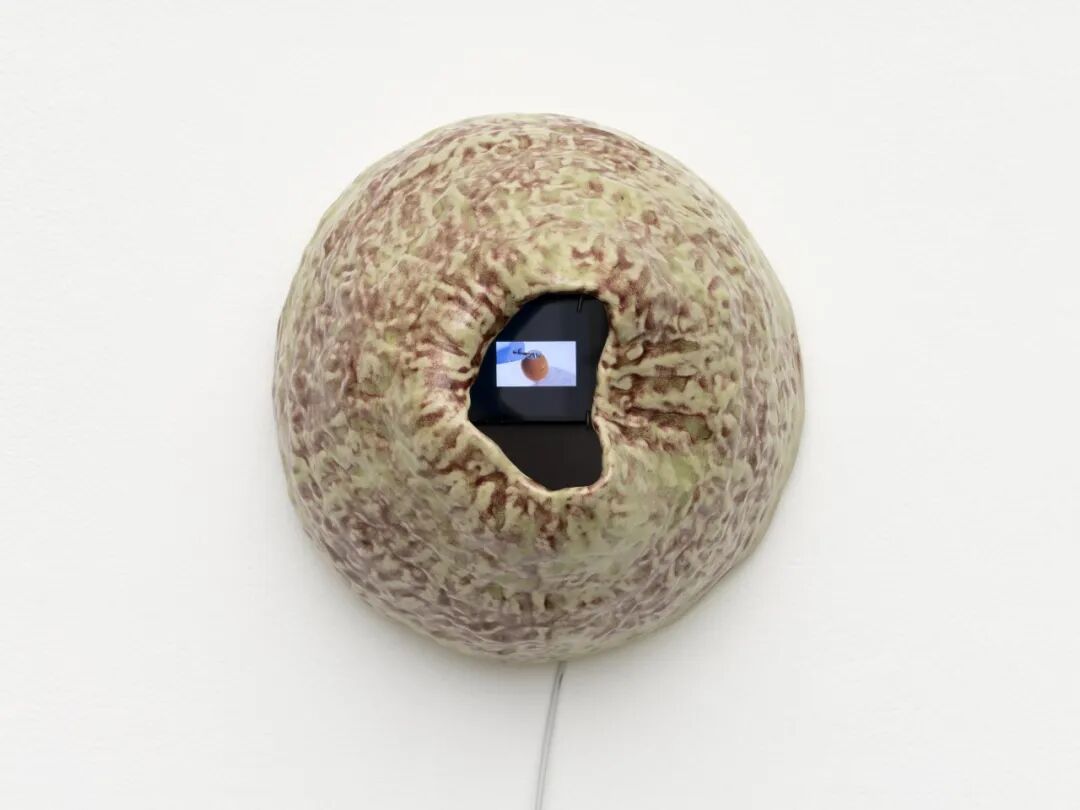
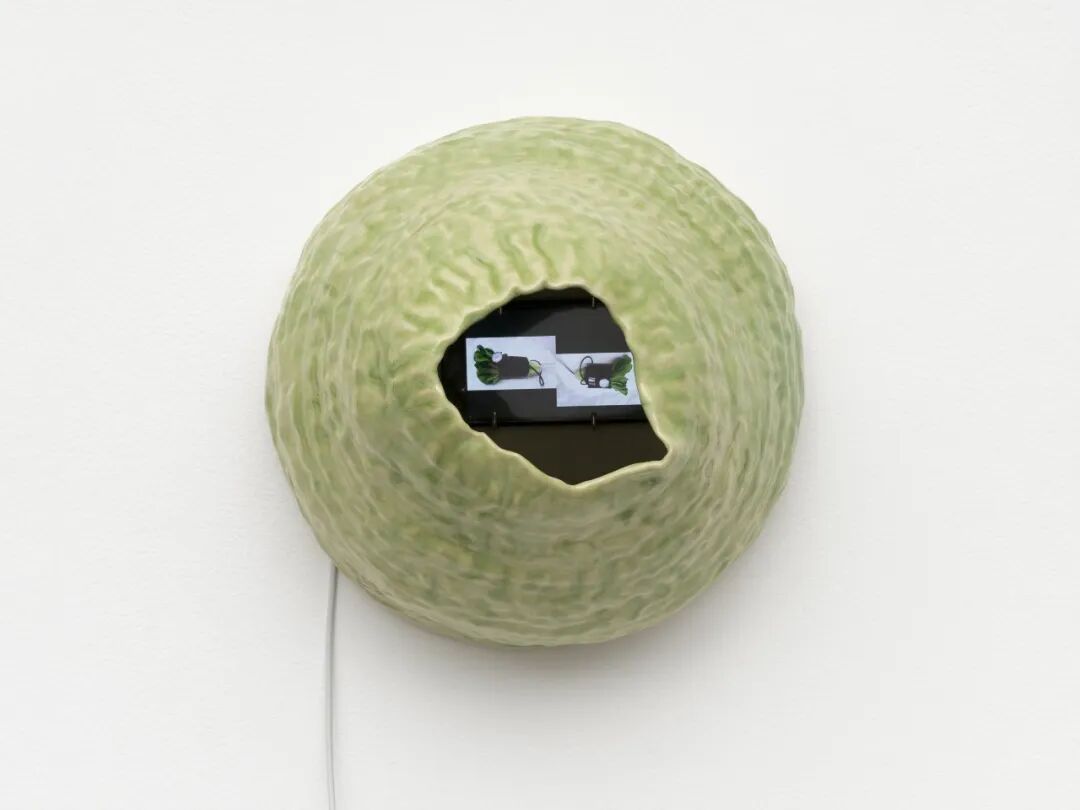
Gaze #3/#4
陶瓷,单频道影像 Ceramics, video
10 x 10 x 8 in. 
摄影 Photo credit: Jueqian Fang
2021-2024
Getting There

单频道影像 single-channel video

1分钟 1’00’’

2021
 

这一系列影像创作于2021年,灵感来自我在疫情后期作为一名留美艺术家的经历。
在全球动荡与政治紧张的背景下,我深刻地感受到个体身份的不确定性,以及在国际环境与制度规则下的局限与无力感。
作品通过现成物与自然元素的结合 来表达这一思考过程。
在物与物的互动中,观者可以感受到个体如何被外部环境挤压、束缚、归类、驯化。
陶瓷外形取自“眼睛”的形态——它象征着“观看”与“认知”。
人类通过双眼去看、去思考、去消化,一次又一次……
来来回回,我们真的知道和了解真相了吗?
 
This video series, created in 2021, was inspired by my experiences as a foreign artist in the United States during the late stages of the global pandemic. At that time, the turbulence of international politics and social conditions compelled me to reflect deeply on the uncertainty of personal identity, as well as the limitations and helplessness imposed by external systems and rules.
 
Through the use of ready-made objects combined with natural elements, the work visualizes this process of contemplation. The interaction between these objects evokes how individuals are squeezed, constrained, grouped, and tamed by their surroundings.
 
The ceramic form takes the shape of an eye, a metaphor for perception. As humans, we see, think, digest, think again, digest again… Back and forth, do we ever truly see and understand the truth?
 
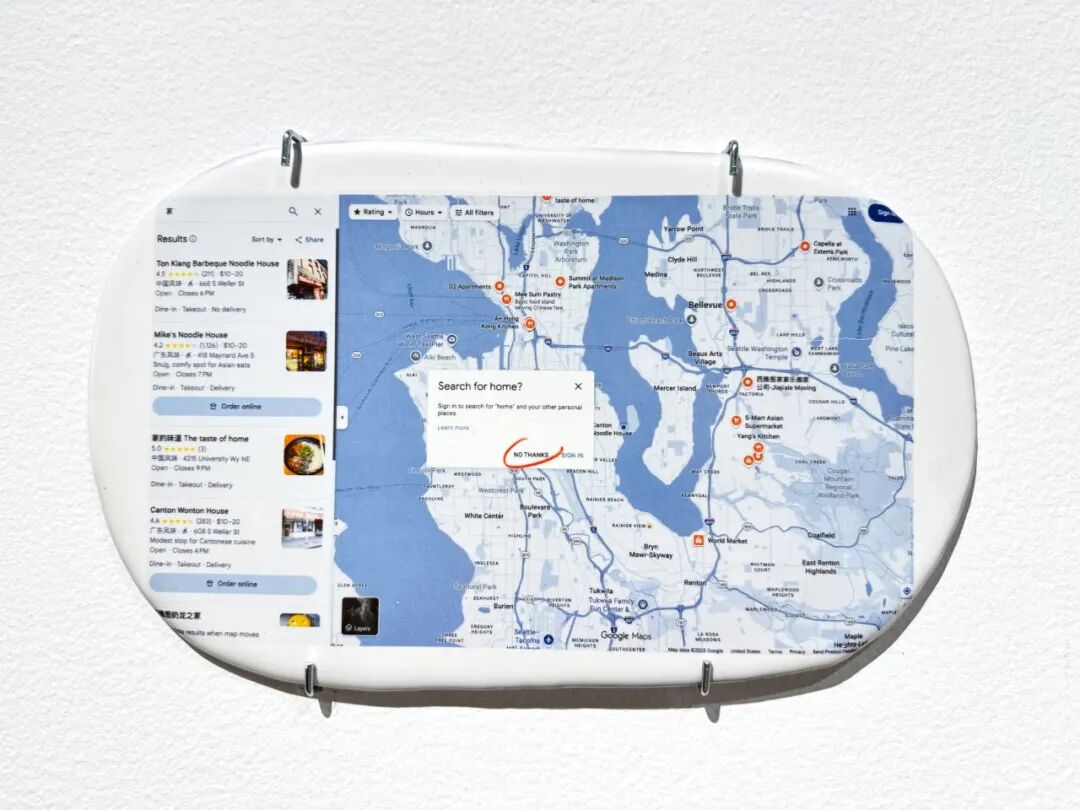
搜索“家”?#1 Search for “home”? #1
搜索“家”?#2 Search for “home”? #2
陶瓷 Ceramics 
13 x 7 英寸 in 
2025
 
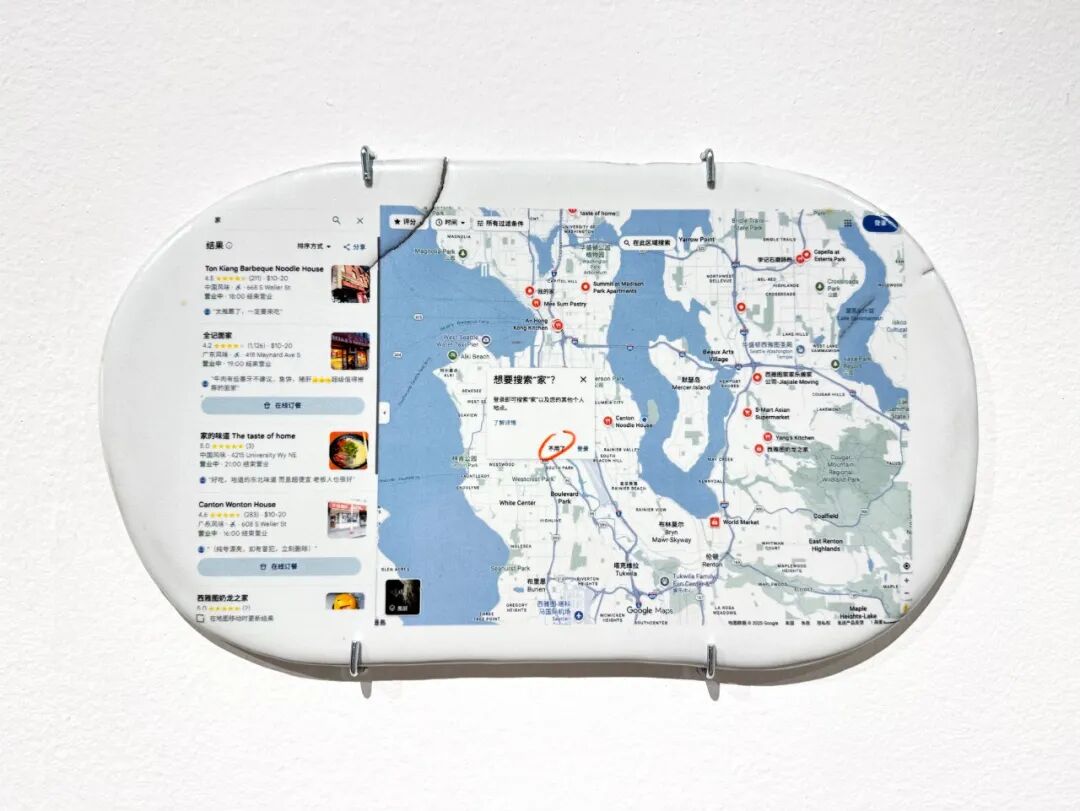
《搜索“家”?》始于一个看似简单却无法真正完成的任务:在 Google Maps 上搜索“家”。作为一个用于定位目的地的平台,Google Maps 将“家”转化为可搜索的数据;然而,人们对“家”的真实经验往往超越了地理位置,而存在于记忆、语言、人与人之间的关系,以及迁徙经验之中。
作品呈现了一次在未登录 Google 账号状态下,对中文“家”的搜索结果。界面随即弹出提示:“搜索‘家’?登录即可搜索‘家’和其他个人地点。”我以红色白板笔圈出了“不了,谢谢(No thanks)”,借此质疑一种预设:家是否真的能够通过个人数据与算法记忆被识别和定义。作品并未找到“家”的位置,而是揭示了“家”本身的不稳定性。
作品通过陶瓷花纸转印将数字界面烧制于瓷板之上,在烧制过程中,图像因开裂、变形与窑烧的不确定性而发生改变。当数字信息在陶瓷表面逐渐碎裂、断裂时,作品也映照出“家”如何在不同语言、文化与地域之间不断被协商与重新定义。
Search for Home? begins with a simple yet impossible task: searching for “home” through Google Maps. Designed to locate destinations, the platform reduces home to searchable data, while the lived experience of home often exceeds geography, existing through memory, language, relationships, and migration.
The work reproduces a Google Maps search for the Chinese word 家 (home) conducted while logged out, prompting the message: “Search for home? Sign in to search for ‘home’ and your other personal places.” By circling “No thanks” with a red dry-erase marker, I question the assumption that home can be identified through personal data and algorithmic memory. Rather than locating home, the search reveals its instability.
Transferred onto ceramic tiles through decal printing, the digital interface is transformed by cracking, warping, and the unpredictability of firing. As digital information becomes fragmented across the ceramic surface, the work reflects on how home is continually negotiated and redefined across languages, cultures, and places.